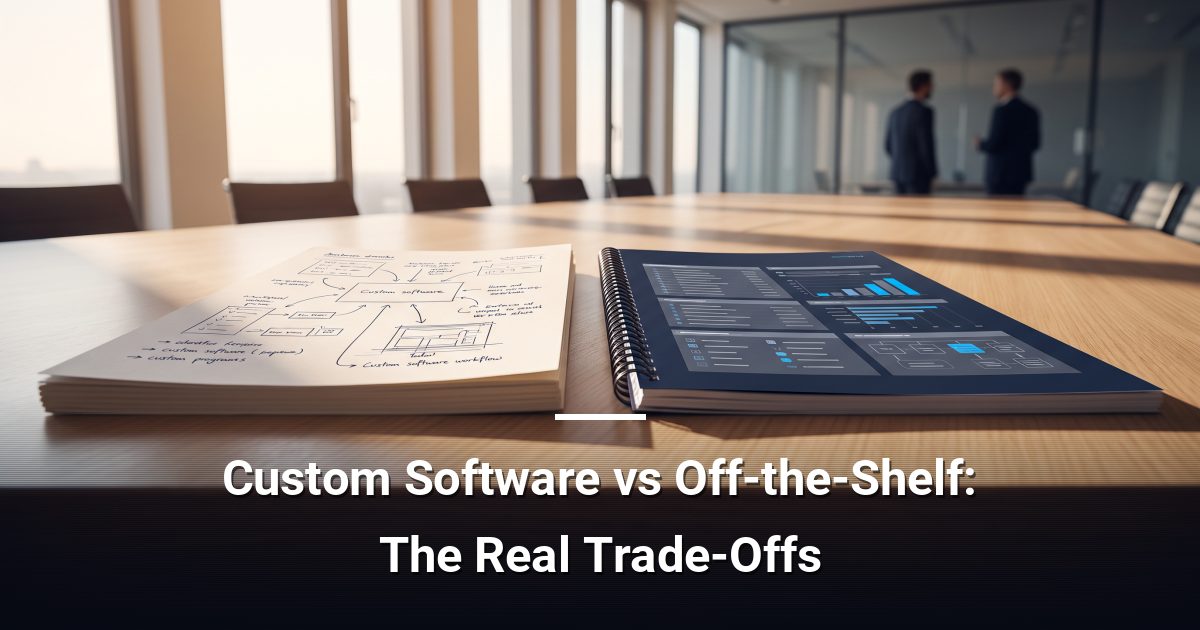
Custom Software vs Off-the-Shelf: The Real Trade-Offs
Custom software vs off-the-shelf: a practical guide covering cost, flexibility, maintenance, and time-to-value so you can choose the right path confidently.
Key Takeaways
- Off-the-shelf software costs less upfront but may force expensive workarounds over time.
- Custom software fits your exact process but requires months before delivering usable value.
- Maintenance responsibility falls entirely on you with a custom build — budget for it from day one.
- A hybrid approach, extending an existing platform, often delivers the best of both options.
- Switching costs are high either way, so evaluate fit carefully before committing, not after.
Choosing between custom software and off-the-shelf solutions means weighing upfront cost against long-term fit. The custom software vs off-the-shelf decision is rarely clear-cut — the right answer depends on how unique your workflows are, how quickly you need results, and how much ongoing investment you can realistically sustain.
What Does Each Option Actually Mean?
Off-the-shelf software is a ready-made product built for a broad market — think accounting platforms, project management tools, or inventory systems. You pay a licence fee, configure some settings, and start using it quickly.
Custom software is built specifically for your organisation, from the ground up or on top of an existing framework. It reflects your exact process, your terminology, and your integration requirements.
How Do the Costs Really Compare?
Off-the-shelf solutions have a lower barrier to entry. Subscription fees are predictable, and you spread cost over time. The hidden expense, however, is adaptation — training staff to work around the tool's limitations, or paying for integrations that bridge gaps between systems.
Custom software carries a higher initial investment in design, development, and testing. Over a longer horizon, a well-built custom tool can cost less per user than stacking multiple subscriptions together.
- Off-the-shelf: Lower upfront cost, faster start, recurring fees, and potential workarounds.
- Custom build: Higher initial spend, built precisely to your process, no licence ceiling.
Why Time-to-Value Matters More Than You Think
Off-the-shelf software can be deployed in days or weeks. If you need a solution now — to solve an immediate operational problem or meet a compliance deadline — that speed is genuinely valuable.
Custom development typically runs from several months to over a year before you have a usable first version. If your process is still evolving, you risk building the wrong thing entirely.
Ask yourself: does this problem need to be fixed this quarter, or is it a long-term strategic gap? The answer shapes which path makes sense.
Who Owns Maintenance — and What Does It Really Cost?
With off-the-shelf software, the vendor handles updates, security patches, and infrastructure. You pay for that through your subscription, but you also accept their release schedule and feature priorities.
With custom software, maintenance is entirely your responsibility. Bugs, security vulnerabilities, and compatibility updates require either an in-house developer or an ongoing contract with the firm that built the system. Neglecting maintenance on a custom build is one of the most common — and costly — mistakes organisations make.
Is There a Middle Path Worth Considering?
Often, yes. Many modern platforms — CRMs, ERPs, field service tools — offer deep customisation through APIs (application programming interfaces, which let different software systems exchange data) and low-code configuration. This hybrid approach lets you adapt a proven product to your workflow without building from scratch.
Before committing to a full custom build, ask whether an existing platform can be extended to cover the vast majority of your needs. The remaining gap may not justify the full cost of a bespoke system.
A Simple Framework for Making the Decision
Work through these four questions before you commit:
- How unique is your process? If competitors use the same workflow, a standard tool likely fits.
- How fast do you need it? Urgency favours off-the-shelf.
- Can you sustain ongoing maintenance? Custom builds require a long-term support plan.
- What are the switching costs if you choose wrong? Data migration, retraining, and lost productivity are real — factor them in early.
Get the Right Advice Before You Commit
The custom software vs off-the-shelf decision has lasting consequences for your operations, budget, and team. MYDWARE helps organisations evaluate software options, map integration requirements, and build a technology roadmap that matches their actual needs. Book a risk and technology assessment to get a clear-eyed view of your options before you invest.
Darryl Cresswell
CEO & President
MYDWARE IT Solutions Inc.