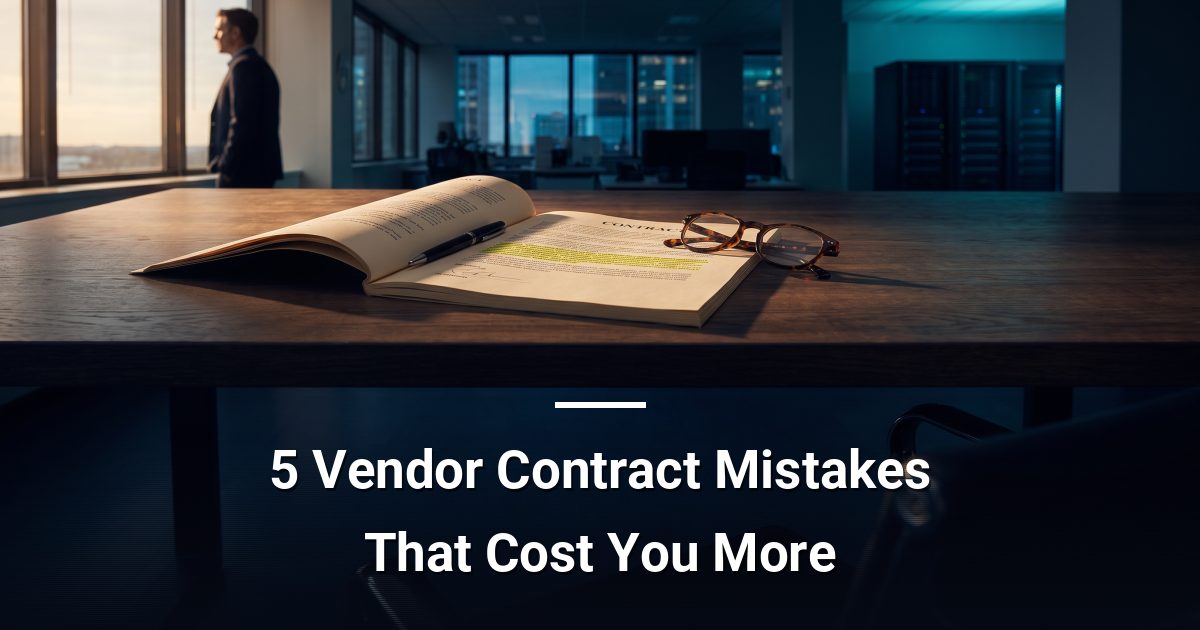
5 Vendor Contract Mistakes That Cost You More
Vendor contract mistakes like hidden auto-renewals and vague SLA language can lock you into costly deals. Here's how to spot and avoid the most common pitfalls.
Key Takeaways
- Auto-renewal clauses can silently lock you into another full contract term if you miss a narrow cancellation window.
- Vague SLA language without defined remedies gives you no real recourse when a vendor underperforms.
- Missing exit clauses can make switching providers expensive and legally complicated.
- Always verify who owns your data before signing — and confirm you can export it when you leave.
- A short legal review before signing is far cheaper than disputing a contract after the fact.
Vendor contract mistakes happen when standard agreements get signed quickly, without close scrutiny. Hidden auto-renewals, weak service-level commitments, and missing exit provisions are among the most common oversights — and each one can quietly increase your costs or trap you with a provider that is no longer serving you well.
Why Are Vendor Contracts So Easy to Get Wrong?
Most technology and service contracts are written by the vendor's legal team, in the vendor's favour. They are long, dense, and designed to be signed quickly. When you are onboarding a new tool or renewing under deadline pressure, it is easy to skim past clauses that will matter a great deal later.
Here are the five mistakes worth watching for.
1. Missing the Auto-Renewal Window
Many contracts renew automatically for a full term — sometimes 12 or 24 months — unless you provide written cancellation notice within a specific window, often 30 to 90 days before the renewal date. Miss that window by a single day and you may be legally committed to another full term. Set a calendar reminder well ahead of every contract anniversary date.
2. Accepting Vague SLA Language
A service-level agreement (SLA) defines what uptime, response time, or performance the vendor promises. The problem is that many SLAs use language like commercially reasonable efforts or best endeavours — phrases that sound reassuring but carry no enforceable standard.
Insist on specific, measurable commitments — for example, 99.9% uptime or a four-hour response time — along with clearly defined remedies such as service credits or the right to terminate if targets are consistently missed.
3. No Exit Clause Beyond Breach
Without a termination for convenience clause — which lets you end the agreement before expiry without proving the vendor did anything wrong — your only way out may be demonstrating a material breach. That is a high legal bar, and pursuing it is costly.
Before signing, ask for a termination for convenience provision with reasonable notice, even if the vendor pushes back. Many will accept it.
Why Does Data Ownership Matter So Much?
Technology contracts sometimes leave data ownership ambiguous. If the agreement does not clearly state that you own your data, a vendor may charge retrieval fees, restrict exports, or delete your records after termination.
- Confirm the contract explicitly states you own all data you provide or generate.
- Verify you can export your data in a usable format at any time.
- Check what happens to your data after the agreement ends — and how long the vendor retains it.
Data portability is not just a convenience; it is a continuity issue. Losing access to your own records during a provider transition can disrupt operations far more than the contract dispute itself.
5. Skipping the Legal Review
A brief review by a lawyer familiar with technology agreements can surface problematic clauses in an hour or two. That cost is a fraction of what an unexpected renewal, a disputed termination, or a difficult data recovery can end up costing you.
Even for mid-value contracts, a one-time review establishes a checklist you can apply to similar agreements going forward — making every future negotiation faster and safer.
How Do You Protect Your Organisation Before Signing?
Build a simple pre-signature checklist: locate the renewal date and cancellation window, confirm SLA metrics and remedies, verify data ownership and export rights, and check for a termination for convenience clause. If anything is missing or unclear, negotiate before you sign — not after.
If you would like a second set of eyes on your technology vendor agreements or want to understand how your current contracts affect your IT risk posture, request a cybersecurity risk assessment from MYDWARE and we will help you identify gaps before they become problems.
Darryl Cresswell
CEO & President
MYDWARE IT Solutions Inc.