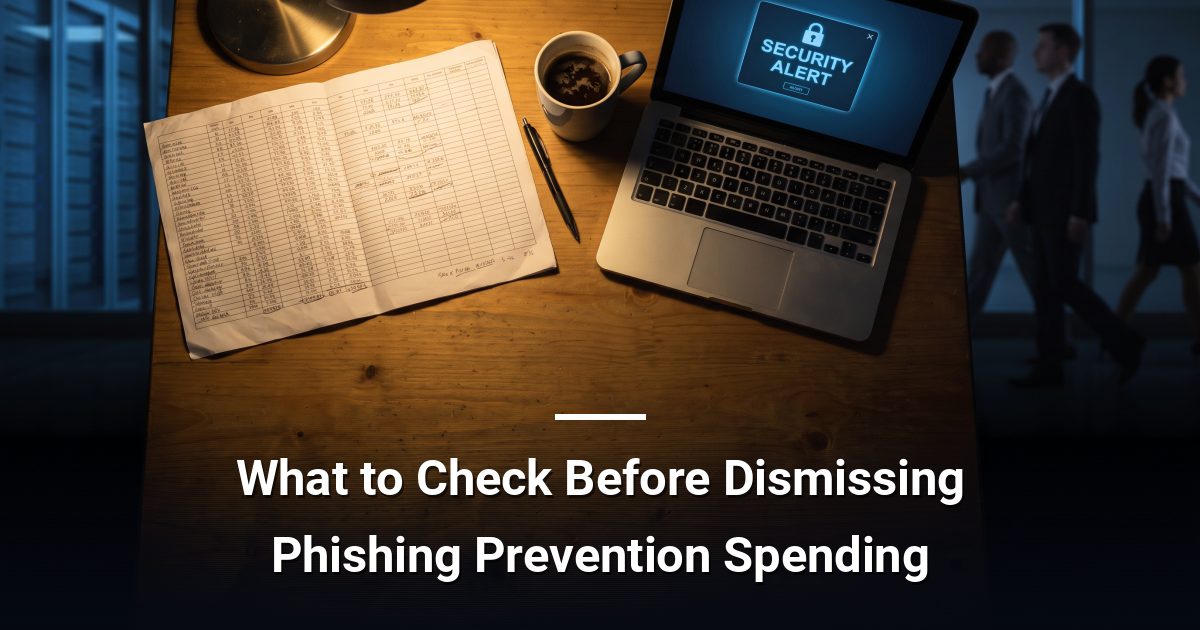
What to Check Before Dismissing Phishing Prevention Spending
Phishing prevention spending is far lower than incident response. See where every dollar goes after a successful attack — and why proactive defence wins on pure arithmetic.
Key Takeaways
- A successful phishing attack triggers expenses across at least five separate budget lines, not just one.
- Forensic investigation and legal fees often exceed the direct financial loss from the attack itself.
- Regulatory fines can compound daily until you demonstrate that systems are secured and compliant.
- Downtime losses accumulate quickly while staff cannot work and IT locks down compromised systems.
- Prevention spending — training, filters, and multi-factor authentication — consistently costs less than a single incident response.
The true argument for phishing prevention spending starts not with what you spend to stop attacks, but with what you pay when one succeeds. Add up incident response labour, forensic investigation, legal counsel, regulatory penalties, lost productivity, and reputation recovery, and a single successful phishing email routinely demands multiples of what a full year of prevention would have required.
What Happens in the First 48 Hours?
The moment a phishing attack is confirmed, several expenses begin running simultaneously.
- Internal IT labour: Your team stops normal work to contain the breach, reset credentials, and isolate affected systems. Even a small IT function can burn dozens of hours in the first two days alone.
- External incident responders: Organisations without a dedicated security operations team typically call in a third-party forensic firm. Qualified incident responders charge substantial hourly rates, and engagements rarely close in under two days.
- Legal counsel: If customer or employee data was exposed, your lawyer needs to be involved from day one to manage notification obligations under Canadian privacy law.
Where Do the Regulatory Expenses Come From?
Canada's federal private-sector privacy legislation requires organisations to report certain breaches to regulators and notify affected individuals directly. Failing to notify on time, or notifying incorrectly, can trigger fines that compound until the regulator is satisfied. Preparing the breach report itself — which legal and compliance staff must draft carefully — adds further expense.
Provincial sector-specific rules in health and finance add another layer. If your organisation handles health records or payment data, reporting requirements are stricter and penalties are higher.
How Much Does Downtime Actually Cost?
While IT investigates, staff cannot safely use email, shared drives, or line-of-business applications. Productivity drops sharply — sometimes to near zero for departments that rely on the compromised systems.
You can estimate your own exposure: multiply your average hourly output per employee by the number of staff affected, then by the hours offline. Even a four-hour outage across a ten-person team produces a visible number; a multi-day lockdown is a different order of magnitude entirely.
What Are the Hidden Losses Most People Overlook?
Reputation and Customer Recovery
After a confirmed breach, some customers leave. Others demand reassurance before renewing contracts. Rebuilding trust requires active effort — communications, third-party security audits, and sometimes public relations support — all of which carry real price tags.
Cyber Insurance Premium Increases
Filing a claim almost always results in a higher renewal premium. Some insurers add exclusions or reduce coverage limits after a successful phishing incident, meaning your next year of coverage costs more and protects less.
Staff Time After the Incident
Mandatory retraining, new policy documentation, and updated procedures all consume hours that would otherwise go toward productive work — a real expense that never appears on an invoice.
Why Does Phishing Prevention Spending Come Out Ahead?
Prevention tools — email filtering, multi-factor authentication (requiring a second proof of identity beyond a password), and regular phishing simulations — address the root cause before any of the above expenses appear. When you stack the full incident bill against the annual price of a layered prevention programme, prevention wins on pure arithmetic in almost every scenario. One incident can exceed several years of proactive defence spending combined.
Ready to See Where Your Gaps Are?
Understanding your phishing prevention spending exposure starts with knowing which controls you already have and which are missing. A structured review surfaces those gaps before an attacker does. Book a no-obligation cybersecurity risk assessment and get a clear picture of what prevention would require — and what it would protect you from.
Darryl Cresswell
CEO & President
MYDWARE IT Solutions Inc.