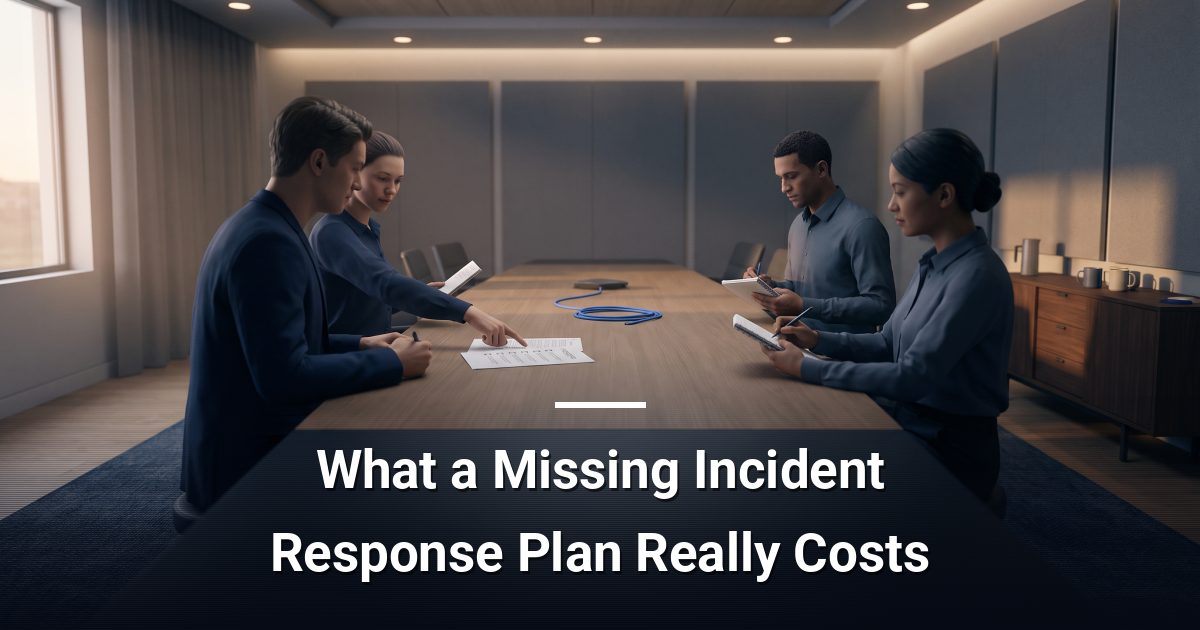
What a Missing Incident Response Plan Really Costs
A cybersecurity incident response plan tells your team exactly what to do after an attack. Discover the real cost of not having one — and 7 steps to build it.
Key Takeaways
- A documented incident response plan reduces recovery time and limits financial damage after a security breach.
- Assign specific roles before an incident occurs so no one wastes critical hours figuring out who is in charge.
- Containment speed matters most — every hour a threat stays active on your network increases the damage.
- Testing your plan with a tabletop exercise reveals gaps that only show up under simulated pressure.
- Without a written plan, even experienced staff default to guesswork when stress is highest.
A cybersecurity incident response plan is a documented, step-by-step procedure that tells every person in your organisation exactly what to do — and in what order — from the moment a security incident is detected until normal operations are restored. Without one, the cost is not just financial; it accumulates in lost hours, compounded damage, and decisions made badly under pressure.
Why Does the Absence of a Plan Cost So Much?
When an incident hits an unprepared organisation, the first hour disappears into confusion: who calls whom, what gets shut down, who notifies clients. That delay is where the real cost accumulates. The longer a threat stays active in your environment, the more data it touches and the harder recovery becomes.
A written plan eliminates the guesswork. It does not require a large IT team to be effective — it requires clarity.
How Do You Build a Cybersecurity Incident Response Plan?
Step 1: Define What Counts as an Incident
Not every alert is a crisis. Establish clear categories — a suspicious login attempt is different from ransomware encrypting your file server. Write down what qualifies as a minor event, a serious incident, and a full emergency. This prevents both under-reaction and unnecessary panic.
Step 2: Assign Roles Before Anything Goes Wrong
Name an incident commander — the single person who makes decisions during a response. Identify a technical lead, a communications lead, and a management contact. Every role must have a named backup in case the primary person is unavailable. Write these names into the document, not just job titles.
Step 3: Build Your Contact List
Your plan needs more than internal contacts. Include your IT provider, your cyber insurance broker, your legal counsel, and any regulatory bodies you may need to notify. Keep this list current and store a printed copy somewhere accessible — if your systems are locked, a digital-only list is useless.
Step 4: Document Your Containment Steps
Containment means stopping the spread before you fix the cause. Your plan should specify which systems to isolate, how to disconnect affected devices from the network, and who has the authority to take a critical system offline. Speed of containment is the single biggest factor in limiting damage.
Step 5: Establish Your Evidence Preservation Process
Before wiping a compromised machine, preserve logs and forensic evidence. This matters for insurance claims, regulatory reporting, and understanding how the attacker got in. Document who is responsible for capturing this evidence and where it is stored securely.
Step 6: Define Your Communication Protocol
Decide in advance what you tell staff, clients, and regulators — and when. Premature or inaccurate communication creates secondary problems. Your communications lead should have approved message templates ready for common scenarios. In Canada, certain breaches trigger mandatory notification requirements under PIPEDA, so know your obligations before an incident forces the question.
Step 7: Test the Plan with a Tabletop Exercise
A plan that has never been rehearsed is a plan that will fail under pressure. A tabletop exercise walks your key people through a simulated scenario — no systems touched, just conversation — to find the gaps. Run one at least once a year and after any significant change to your infrastructure or team.
What Should You Do After an Incident Is Resolved?
Recovery is not the end of the process. Conduct a post-incident review within two weeks. Document what happened, what the plan got right, and what it missed. Update the plan accordingly. Organisations that treat every incident as a learning opportunity build progressively stronger defences over time.
Take the Next Step Before You Need It
The best time to build your cybersecurity incident response plan is well before any incident occurs. If you are not sure where your gaps are, book a cybersecurity risk assessment with MYDWARE — we work with organisations across the region to identify vulnerabilities and put the right response procedures in place before a threat forces your hand.
Darryl Cresswell
CEO & President
MYDWARE IT Solutions Inc.