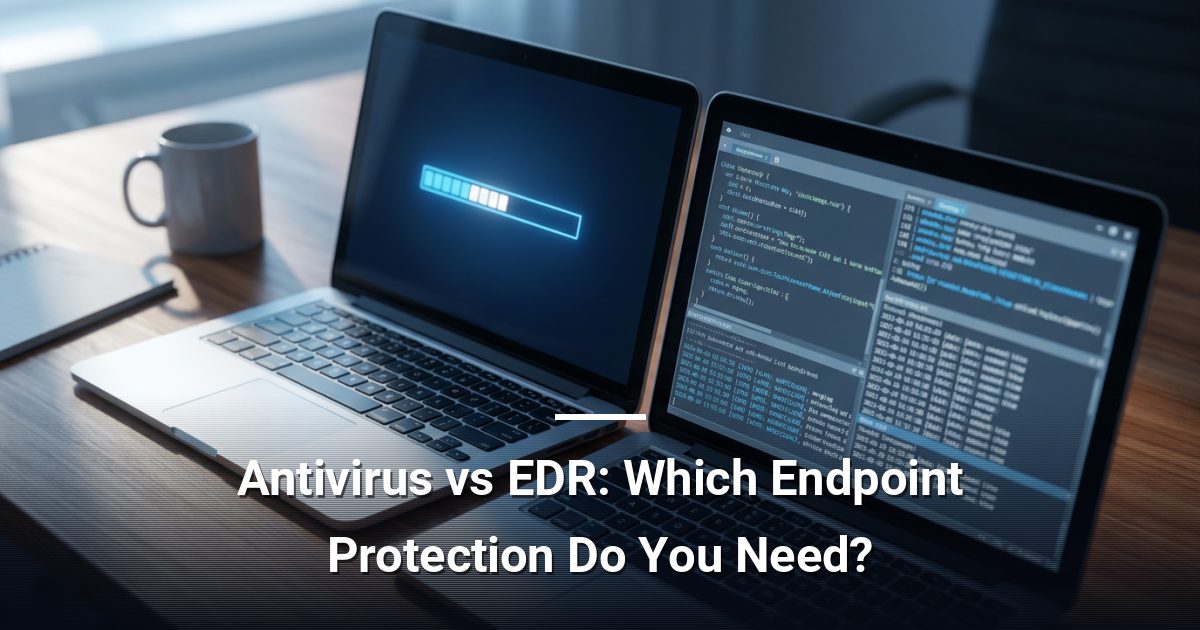
Antivirus vs EDR: Which Endpoint Protection Do You Need?
Antivirus vs EDR: understand the real differences, cost trade-offs, and risk factors to choose the right endpoint protection for your environment.
Key Takeaways
- Traditional antivirus blocks known threats but cannot detect attackers already operating inside your network.
- EDR monitors device behaviour continuously, enabling rapid investigation and containment of active threats.
- Your risk exposure — not your headcount — should determine which protection level you actually need.
- Regulated environments handling sensitive data almost always require EDR-level visibility to meet compliance obligations.
- A well-configured antivirus with layered controls remains a reasonable baseline for genuinely lower-risk environments.
Antivirus vs EDR is ultimately a question of how sophisticated the threats you face are likely to be. Traditional antivirus matches files against a database of known malware signatures. Endpoint Detection and Response (EDR) — software that continuously monitors device behaviour — goes further, catching attacks that leave no recognisable signature at all.
What Does Traditional Antivirus Actually Do?
Antivirus software scans files and programmes against a constantly updated list of known malicious code. When a match is found, the file is quarantined or deleted. It is fast, lightweight, and inexpensive.
The core limitation is the word known. Antivirus is largely reactive. It cannot detect a threat it has never seen before — and modern attackers frequently use novel techniques specifically to avoid signature detection. Fileless attacks, for example, run entirely in system memory and leave no file for antivirus to scan.
How Does EDR Work Differently?
EDR tools record a continuous stream of activity on every endpoint — every process launched, every network connection made, every file opened. When behaviour looks suspicious, the system raises an alert and, depending on configuration, can automatically isolate the affected device.
This approach catches threats that antivirus misses entirely:
- Attackers who have already bypassed the perimeter and are moving laterally through your network
- Credential theft attempts that use legitimate system tools
- Ransomware behaviour detected before encryption completes
EDR also creates a forensic timeline — a detailed record of what happened and when — which is critical for understanding the full scope of an incident.
What Are the Real Cost Differences?
Antivirus licences are typically a fraction of the cost of EDR. EDR platforms cost more per device per month and, more importantly, generate alerts that someone must review and act on. Without a person or a managed service monitoring those alerts, EDR provides visibility without response — which is only half the value.
Factor in these costs honestly:
- Licence fees per endpoint
- Internal staff time to triage alerts, or the cost of outsourcing that function
- The potential cost of a breach that a less capable tool failed to catch
Which Risk Factors Point Toward EDR?
Your threat exposure — not your headcount — is the deciding factor. EDR is worth the investment if any of the following apply to your environment:
- You store regulated data such as personal health information, financial records, or payment card data
- Staff regularly work remotely on devices outside your office network
- You rely on cloud services and third-party integrations that expand your attack surface
- A ransomware outage would cause significant revenue loss or reputational damage
- Your sector is a known target — legal, accounting, healthcare, and financial services all qualify
When Is Antivirus Still Sufficient?
A well-configured antivirus paired with other controls — strong password policies, multi-factor authentication, regular patching, and staff awareness training — remains a reasonable baseline for lower-risk environments. The key word is layered: antivirus alone, without those supporting controls, leaves meaningful gaps regardless of your risk level.
How Do You Make the Final Call?
Work through three questions. First, what data do you hold and what are the consequences if it is stolen or encrypted? Second, do you have someone — internal or external — who can act on security alerts within hours, not days? Third, do any compliance frameworks you operate under require advanced endpoint monitoring?
If the answer to any of these is yes, EDR is the more defensible choice. If your data is low-sensitivity, your environment is simple, and you have solid layered controls already in place, a quality antivirus product may genuinely be enough for now.
Get a Clear Picture of Your Current Exposure
If you are unsure which protection level your environment actually warrants, a structured assessment will give you a clear, honest answer. MYDWARE helps organisations evaluate their endpoint security posture and choose the right tools for their specific risk profile — without overselling. Book a cybersecurity risk assessment and find out exactly where you stand.
Darryl Cresswell
CEO & President
MYDWARE IT Solutions Inc.