What Edge Computing Really Costs Your Operations
Edge computing costs more than a software subscription — hardware, maintenance, and security all shift to you. Find out what's involved before committing.
Key Takeaways
- Edge computing processes data locally on-site, eliminating the round trip to a remote cloud server.
- Upfront hardware investment, ongoing maintenance, and security responsibilities all land on your organisation.
- Latency reduction is the core benefit — critical systems act in milliseconds rather than waiting on the cloud.
- Edge deployments expand your attack surface, requiring stricter patching and physical access controls.
- Cloud-first remains the right fit for many workloads — edge computing solves specific problems, not every problem.
Edge computing costs more than most organisations anticipate because it is not a software subscription — it requires physical hardware on your premises, ongoing maintenance your team must own, and a security perimeter that grows with every device you add. Understanding those edge computing costs honestly is the only way to decide whether the benefits justify the commitment.
What Does Edge Computing Actually Do?
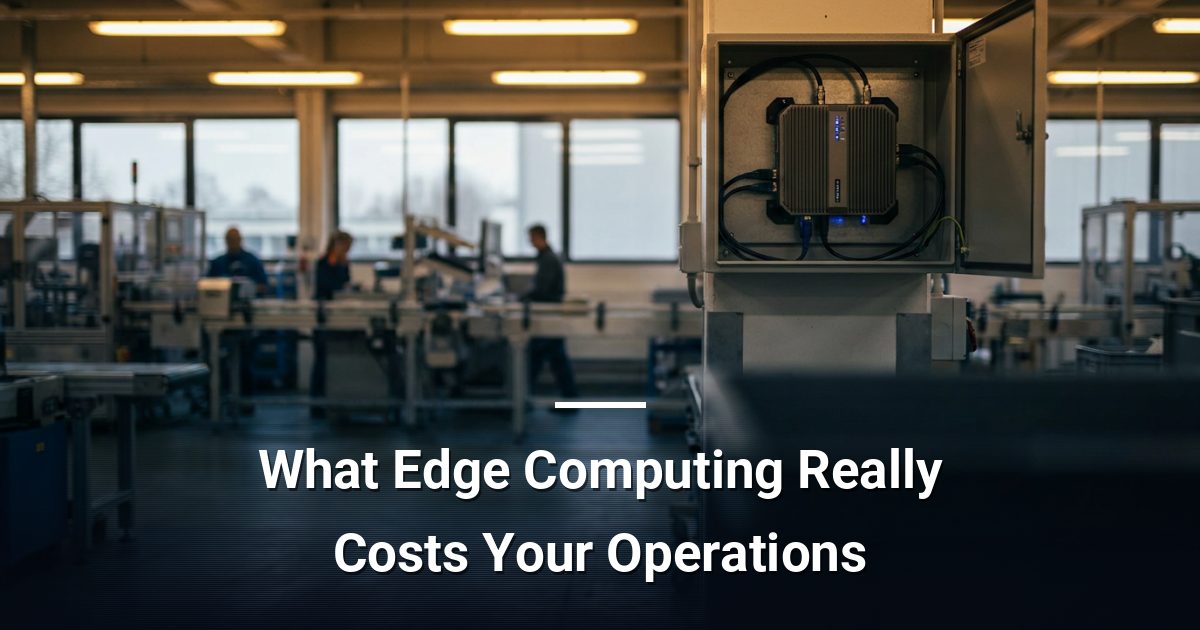
In a standard cloud setup, data travels from a device — a sensor, a camera, a machine — to a remote server, gets processed, and a result comes back. That round trip takes time. Edge computing eliminates most of that round trip by processing data on a local device or small server physically close to the source.
The practical result is that your systems can act on data in milliseconds rather than waiting on a distant data centre. That matters in warehouses with automated conveyor systems, clinics with connected monitoring equipment, and retail locations with smart inventory sensors — anywhere a delayed response is a real operational problem.
Why Does Latency Matter More Than You Might Think?
Latency is the delay between sending data and receiving a response. In everyday office applications — email, file sharing, video calls — a fraction of a second is invisible. In operational environments, it compounds quickly.
- A connected machine that takes two seconds to respond to a fault signal can trigger costly downtime.
- A security camera system relying on cloud analysis may miss a real-time alert window entirely.
- A point-of-sale system dependent on cloud connectivity fails completely during an internet outage.
Edge computing keeps these systems functional and fast regardless of what is happening with your internet connection.
What Are the Real Costs of an Edge Deployment?
This is where organisations are most often caught off guard. Edge computing introduces three distinct cost categories that deserve honest evaluation before you commit.
Upfront Hardware Investment
Edge deployments require physical hardware: edge servers, ruggedised devices, or gateway appliances installed on your premises. These are capital expenses, not monthly fees, and they scale with the size of your deployment.
Ongoing Maintenance and Support
Unlike cloud infrastructure maintained by a vendor, edge hardware is entirely your responsibility. Firmware updates, hardware failures, and configuration changes all fall to your IT team or managed services provider. This overhead is consistently underestimated at the planning stage.
Security at the Edge
Every edge device is a potential entry point for attackers. Distributed hardware across a facility — or multiple locations — expands your attack surface. Security patching, physical access controls, and network segmentation all become more demanding when processing happens locally rather than in a managed data centre.
When Does Edge Computing Make Sense?
Edge computing is not a universal upgrade. It is a targeted solution to specific operational problems. It warrants serious consideration when your situation meets one or more of these conditions:
- You rely on real-time data from connected devices or machinery where delays cause measurable harm.
- Internet outages would halt critical processes if cloud dependency exists.
- Regulatory or privacy requirements restrict sending certain data off-site.
- You operate in a location with limited or unreliable internet bandwidth.
If none of these apply, a well-configured cloud environment almost certainly remains the more cost-effective and lower-maintenance choice.
How Should You Evaluate the Trade-offs?
Edge computing shifts complexity rather than removes it. You trade cloud dependency and latency for on-premises hardware responsibility and a larger security perimeter. Neither model is inherently superior — the right choice depends on your specific workloads, your tolerance for downtime, and your capacity to maintain distributed infrastructure.
Before committing to an edge deployment, map out exactly which processes require local processing, what the realistic cost of latency or an outage is in those processes, and whether your IT support model can absorb the added maintenance burden.
Ready to Assess Your Infrastructure Honestly?
Deciding whether edge computing fits your environment starts with a clear-eyed look at what you already have and what you actually need. Book a complimentary cybersecurity and infrastructure risk assessment with MYDWARE to get an honest picture of your current setup and where edge or cloud investments would genuinely serve you.
Darryl Cresswell
CEO & President
MYDWARE IT Solutions Inc.